Showing posts with label Whorled Milkweed. Show all posts

Saturday, August 10, 2013

Allegan Forest, Allegan County Michigan - Part 2

Back to our day in Allegan County Michigan.  This was late July.
Wild Bergamot

After Marie and I left Happy Boots Corner we went west on M-89 past Swan Creek Marsh, on the north side of the road is part of the North Country Trail.  We followed along this trail for about 1/2 mile in, then back out.
On this trail we found...
Horse Nettle (Solanum carolinense)  Nightshade family, "the round fruits develop that are a little more than ½" across and half-enclosed by a papery calyx. They become yellow when mature, but are not edible to humans. Each fruit contains numerous seeds that are glossy yellow and flattened",  I think they look like bananas.

Spotted Horsemint (Monarda punctate) Mint Family. Yellow, purple spotted flowers in dense whorls with flowers surrounded by conspicuous white or lilac bracts.


Woodland Sunflower

Harebell


Harebell (Campanula rotundifolia ) Bellflower family.  This is a charming little plant.
We also saw Aniseroot, Lopseed, Striped Wintergreen, Yarrow, a goldenrod, and a few more wildflowers along this trail.

Back in the car we go, deep into the Allegan Forest.
Around the corner and down a two-track to Ottawa Marsh river access along the Kalamazoo River.
Kalamazoo River

 Here we saw Monkey Flower (Mimulus ringens)  Figwort family. These plants are named for their showy flowers, which resemble the heads of grinning monkeys.  I've never seen the "monkey" in this flower. 

There is a Michigan Monkey Flower and it is said that, "A botanist was once served a sprig of Michigan monkey-flower (Mimulus michiganensis) as a garnish on a restaurant dinner plate, leading to the discovery of a new population of this species!"

Common Mallow or Cheeses (Malva neglecta) Mallow Family.

Hoary Vervain (Verbena stricta) Vervain family
There was one Hoary Vervain in the parking area.

Kalamazoo River
We also saw several Tall (American) Bellflower
(Campanulastrum americanum)  Bellflower family

This native plant is an annual or biennial from 2-6' tall.


 Again down the road and around a few corners to our American Columbo field.  What is American Columbo?

We need to go back a few years to 2009 when we discovered some large rosettes of basal leaves here in Allegan County.  Well, Marie (the brains of our duo) concluded these were the basal leaves of the American Columbo! 

We went back to find American Columbo blooming in June 2010.

American Columbo (Frasera caroliniensis) Gentian family


Here is some info on this plant, "American Columbo is an unusual native plant that has a tall striking appearance when it finally bolts and blooms. The greenish white flowers with purplish specks or streaks have an odd appearance; they are produced in great abundance during the blooming period.  This herbaceous plant is a monocarpic (Monocarpic plants are those that flower, set seeds and then die) perennial.


            American Columbo May 14, 2012

It persists as a rosette of 3-30 basal leaves for 5-15 years (or more), finally bolting as a flowering plant that becomes 3-8' tall for a single season, and then dying."
 
     Central stem of American Columbo
 
"American Columbo  is actually a triennial usually taking three years to reach maturity. Two years of basal leaves and the third year a dark burgundy stalk about 1 inch in diameter grows with a terminal flower cluster."
"Leaves: The leaves are whorled. Leaves can reach 18 inches in length. Each leaf is entire.
Flowers: The flowers have 4 Regular Parts and are up to1.3 inches wide.  They are light green with purple spots. Blooms first appear in late spring and continue into early summer. The top of the plant is a large panicle
of flowers.
Habitat: Rich open woods and dry open areas especially limestone soil.
Range: Most of eastern US except extreme north and south. Rare. "


I have to admit it, Marie and I find some interesting things here in Michigan.
But wait there's more!  We found and Marie identified another plant we had never noted before. We noticed it was something different.  I was thinking it might be a knapweed, but she sat right down and made the identification.
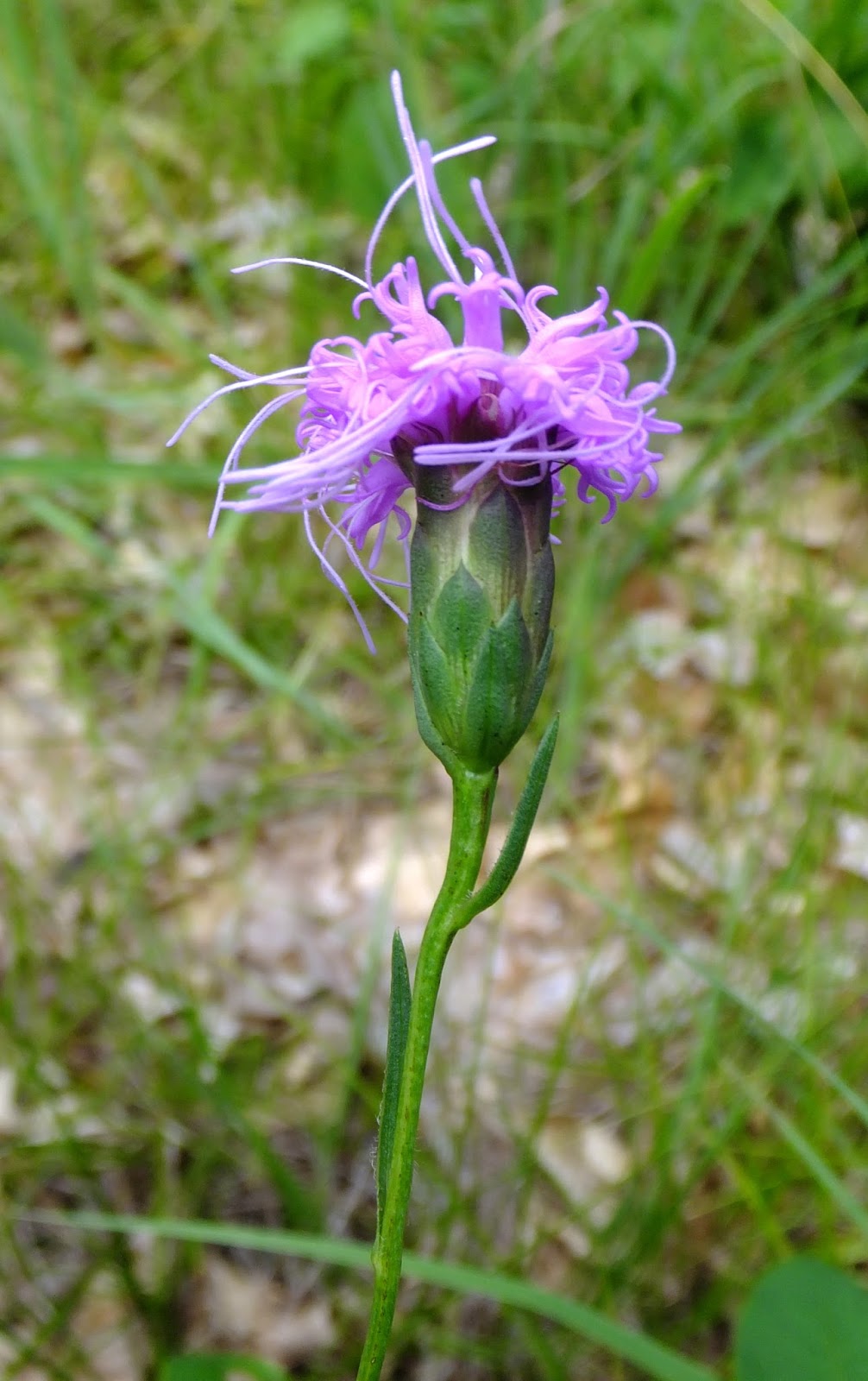
 Cylindric Blazing-Star (Liatris cylindracea)  Aster family

"This native perennial plant is 1–1½' tall and unbranched. The central stem is largely hairless, except for a few hairs near the inflorescence. The leaves are up to 8" long and 1/3" across, becoming smaller and fewer as they ascend the stem. These leaves appear whorled because of their density, but they actually alternate around the stem."

"This is a lovely Blazingstar; it is much shorter than most of the others, and tends to bloom earlier. Cylindrical Blazingstar is easy to identify because of the smooth cylindrical surface formed by the green bracts subtending the flowers; this cylindrical surface is longer and larger than what is encountered in other Blazingstars."
Now we know right?

One more before I finally end this.  Whorled Milkweed.  We have seen a few of these plants at Bass River Rec Area but here there were many of them.
  Whorled Milkweed (Asclepias verticillata)  Milkweed family
This native perennial plant is unbranched and up to 2' tall. Whorls of 4-8 linear leaves occur along the slender central stem.


"This little milkweed blooms later in the year than many other members of the genus, and is good at attracting butterflies. The foliage of this plant resembles a horsetail, but the flowers reveal its membership in the Milkweed family. It can be distinguished from other milkweeds by its skinny whorled leaves and greenish white flowers."

Maybe just one more flower this beautiful Butterfly Weed.  It was such a deep red-orange.

Time to wrap up this day in July 2013.  This was the day we saw at least 67 wildflowers, the list is on the last post.  So much fun!

Friday, August 13, 2010

Catching up on Bass River Rec. Area


2010 08 02 - We visited the east end of Bass River Rec. Area, (in Ottawa County, owned by Michigan Department of Natural Resources) it was hot, muggy, and buggy!  We visit one of our favorite hidden wet areas, and got to slosh around in our boots a bit.  Later we were wilting so we got in the van with the AC going full blast and did more wildflowering along the road.    

                                                   Looking east toward Bass River

                    Smartweed , Polygonum (Pink or Maybe Swamp)


Chicory
 
Fringed Loosestrife

Frogfruit (Phyla nodiflora)

                                                Red Dragonfly (not his real name)


Whorled Milkweed
 
   Swamp Milkweed

     Cardinal Flower
These are just some of the plants and wildflowers we saw, yes there were more!

Tuesday, July 13, 2010

Bass River Recreation Area

Monday is our regular adventure day, mostly, although we sometimes add a Thursday in there. July 12 we checked out Bass River Rec Area owned by the State of Michigan.

This area is over one thousand acres of land and water, some say 1665 acres, I didn't actually measure it. We have been here many times before and have stumbled across orchids, gentians, and many other cool wildflowers.

We both have knee high boots so we can get into those mucky places better, that's where I always think the rare orchids will be. Since this was a gravel pit we don't go far into the water because it quickly gets very deep.

With so many acres it is easy to get turned around here, but with big Bass Lake, the Grand River, and well traveled two tracks you don't get lost. We did walk over 3 1/2 miles trying to find the hidden place where we first found Ladies' Tresses, even though we knew it was too early for them to be blooming.

Again it was a great day, even with the heat, humidity, and mosquitoes. We also made a quick stop at Connor Bayou which is an Ottawa County Park.

Whorled Milkweed


Field of Everlasting Pea! (I call these Everlasting Gobstoppers)


Scouring Rush (Horsetail or Take-Aparts)


American Germander


Clymene Moth


Chicory


Hidden pond at Bass River Rec Area